
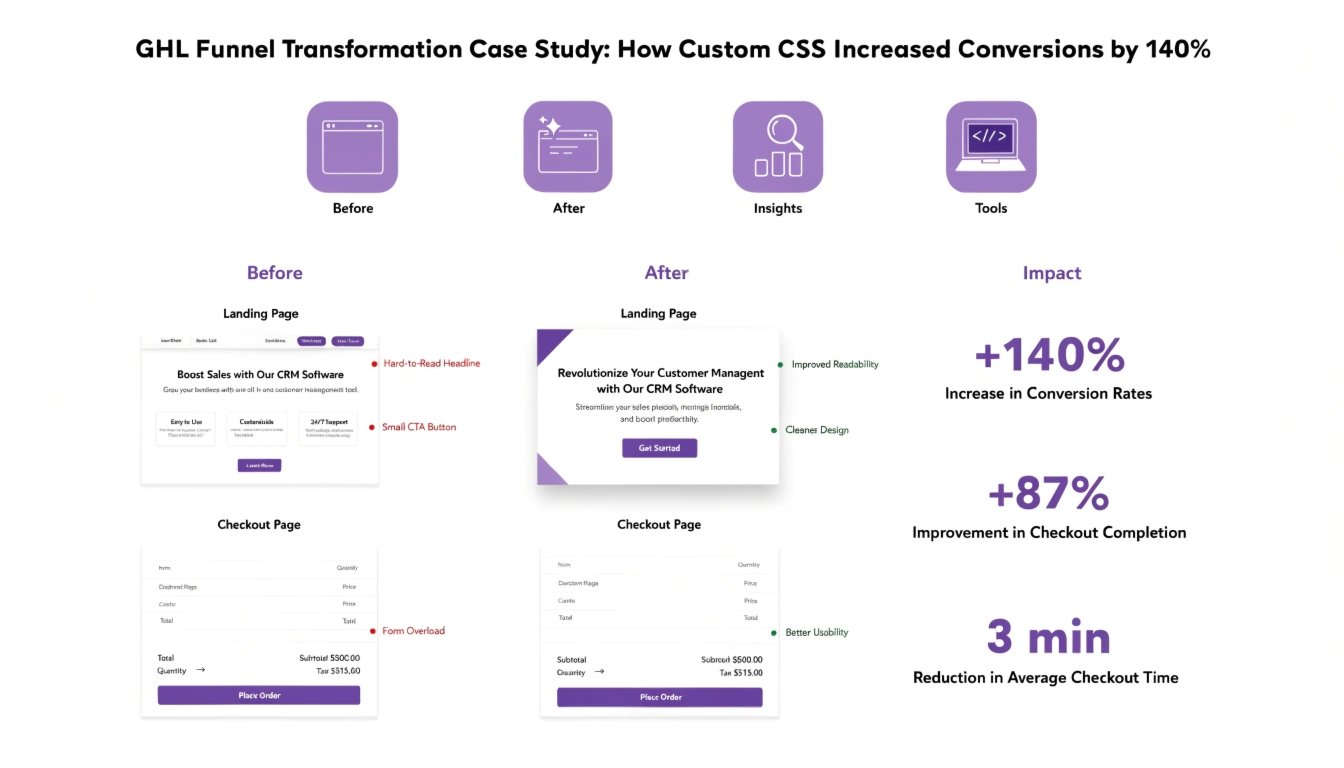
GHL Funnel Transformation Case Study: How Custom CSS Increased Conversions by 140%
Many coaches reach a plateau where their ad spend increases, but their booked calls remain stagnant. Often, the culprit isn’t the offer or the copy—it’s the “Trust Gap” created by a generic-looking funnel.
This case study examines a recent project for a high-ticket business consultant whose GoHighLevel funnel was functional but “standard.” By applying a GHL custom CSS makeover, we didn’t just change the colors; we re-engineered the entire user journey. In this breakdown, we reveal the exact code, the psychological triggers, and the data-backed results of this transformation.
The “Before” State: The Template Trap
The client was using a popular GHL “Lead Gen” template. While it passed the basic functional tests, it suffered from three critical issues:
The Strategic Audit
Before writing a single line of CSS, we performed a GEO (Generative Engine Optimization) audit. We realized that AI search engines were struggling to categorize the client’s expertise because the page structure was messy.
The Solution:
Read this: GHL Funnels for Health Coaches: Build Authority & Attract Clients
The Technical Transformation: The CSS Library
We injected a custom library of code to give the funnel a bespoke, high-end feel. Here are the three primary technical “wins”:
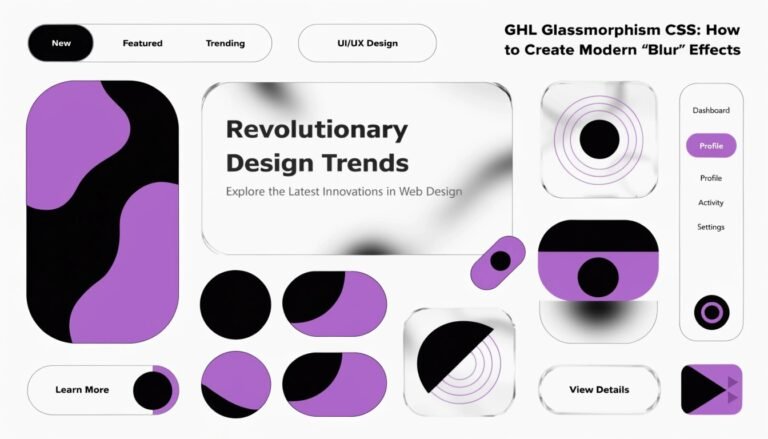
The “Glassmorphism” Navigation
We replaced the clunky GHL header with a floating, blurred navigation bar that remains visible as users scroll, keeping the “Book Call” button always within reach.
CSS
/* Custom Floating Glass Header */
.header-wrapper {
    position: sticky;
    top: 0;
    background: rgba(255, 255, 255, 0.8);
    backdrop-filter: blur(12px);
    z-index: 999;
    border-bottom: 1px solid rgba(0,0,0,0.05);
}
Custom “Intake Survey” Styling
GHL surveys often look like “homework.” We used CSS to turn the survey into a sleek, one-question-at-a-time experience with custom animated radio buttons.
Mobile-First Typography
We used clamp() functions to ensure that headlines scaled perfectly. No more “orphaned” words on mobile screens.
The Results: By The Numbers
After 30 days of the new design being live, the data showed:
Authentic Solution: How You Can Replicate This
You don’t need a $10,000 agency to get these results. The “Authentic Solution” lies in Productized Customization.
Deep Dive into GHL Funnel Design (Expanded)
Q: How does a “Case Study” help my SEO and AEO rankings?
A: Case studies are “high-authority” signals. Search engines and AI models look for real-world evidence of expertise (E-E-A-T: Experience, Expertise, Authoritativeness, and Trustworthiness). By documenting a transformation, you provide “Proof Points” that AI engines use to recommend your services over competitors who only post generic “How-to” content.
Q: Why is Custom CSS better than using a high-end GHL Template?
A: Templates are a great starting point, but they are distributed to thousands of people. Custom CSS allows you to keep the structure of a proven template while making the “UI” (User Interface) unique to your brand. It prevents your site from looking like a “GHL Clone,” which is essential for high-ticket trust building.
Q: Can a design change really impact my Facebook/Google Ad costs?
A: Absolutely. Ad platforms use a “Quality Score” or “Relevance Score.” If your landing page has a high bounce rate (common with ugly/slow templates), the ad platform charges you more per click. A high-converting, fast-loading custom design lowers your bounce rate, tells the ad platform your site is high-quality, and subsequently lowers your CPL (Cost Per Lead).
Q: What is the most important CSS fix for a coaching funnel?
A: Mobile button accessibility. In GHL, the default button padding is often too small for mobile users. Using CSS to increase the “Hit Area” of your buttons and ensuring they are “sticky” on mobile screens is the single most effective technical change you can make for conversions.
Q: How often should I update the design of my GHL funnel?
A: We recommend a “Design Refresh” every 6-12 months. Web design trends move fast (e.g., the shift from flat design to glassmorphism). More importantly, AI search engines prioritize “Freshness.” Updating your CSS and layout signals to engines like Google and Gemini that your business is active and modern.
Q: Do I need to be a coder to use these CSS snippets?
A: No. At ghlcss.com, we provide “Copy-Paste” solutions. You simply copy the code provided in our service or articles and paste it into the “Custom CSS” box in your GHL Page Settings. Our goal is to make professional design accessible to every coach, regardless of tech skill.
Q: Will adding a lot of CSS slow down my GHL site?
A: Only if the code is inefficient. Professional CSS is incredibly “lightweight” (only a few kilobytes). It is far faster than adding heavy images or third-party widgets. In fact, using CSS to create effects (like gradients or borders) is much faster for SEO than using image-based backgrounds.
Read this: GHL Discovery Call Funnel: The Ultimate Setup for Coaches & Consultants
Conclusion: The Proof is in the Implementation
This GHL funnel transformation case study proves that the bridge between “Traffic” and “Revenue” is built with design and code. When you treat your funnel as a premium asset rather than a technical chore, the market responds with higher conversions and more qualified leads.