
Hire a GHL Designer: 7 Questions to Ask Before You Pay (2026)
In our experience working with over 100 coaches at ghlcss.com, the average coach who hires a GHL designer poorly loses $2,300 and 6 weeks before getting a funnel that actually converts. That’s not the designer’s fee — that’s the waste: deposits that don’t get refunded, revisions that never finish, and the lost revenue from a launch that gets pushed back twice.
The problem isn’t that good GoHighLevel designers don’t exist. They do. The problem is that GHL is a niche skill, and most freelancers marketing themselves as “GHL experts” are general web designers who learned the GHL builder over a weekend. They can drag-and-drop a page. They cannot write the custom CSS that makes your funnel look like a $50,000 brand instead of a $50 template.
The 7 questions below separate real GoHighLevel specialists from drag-and-drop generalists. Each question has:
Let’s start with the most important one.
What Is a GHL Designer?
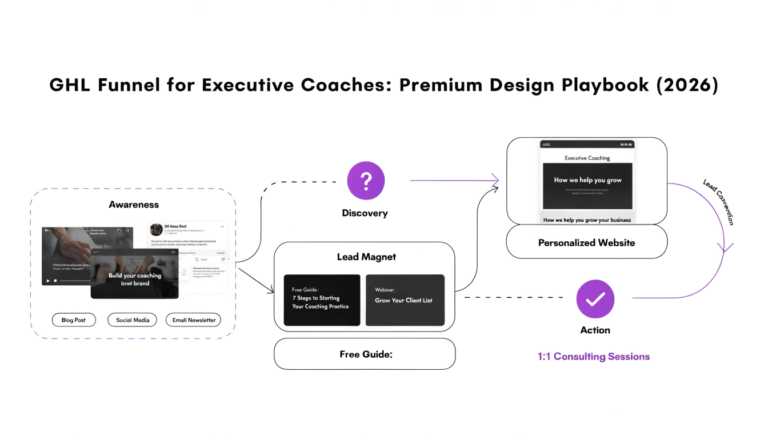
A GHL designer is a specialist who builds, customizes, and styles funnels inside GoHighLevel — the all-in-one CRM and funnel platform used by 600,000+ businesses. Unlike a general web designer, a GHL designer knows the platform’s specific CSS selectors, automation triggers, calendar integrations, and template limitations. The best GHL designers combine three skills: visual design, custom CSS, and an understanding of coaching conversion psychology.
Think of it this way: a general web designer is a chef who can cook anything. A GHL designer is a chef who specializes in one cuisine — they know every ingredient, every technique, every trick that makes that cuisine sing. For coaching funnels, that specialization is the difference between a funnel that looks “fine” and a funnel that books 30 discovery calls in its first week.
| Need a quick decision instead of reading further? If your funnel just needs a refresh (not a full rebuild), our GHL Funnel CSS Makeover takes 48 hours and starts at $197 — no hiring process required. |
Can I See Your Last Three Coaching Funnels?
The answer to listen for: A specific, live URL for each funnel — ideally a coaching funnel similar to yours. They should walk you through why they made specific design choices: “We used a sticky booking button here because the page is long” or “We chose this serif font because it’s a high-ticket executive coach.”
The red-flag answer: “I can’t share client work for privacy reasons” — followed by a generic portfolio site with stock-photo mockups. Privacy is sometimes legitimate, but every real designer has at least 2–3 funnels they’re allowed to show.
Why this matters: A portfolio is the only proof of skill. Promises don’t convert. According to a 2025 freelancer survey by Upwork, 68% of clients who didn’t review live portfolio links before hiring reported being dissatisfied with the final deliverable. Looking at three coaching funnels takes 15 minutes. Recovering from a bad hire takes 6 weeks.
What to look for in their portfolio:
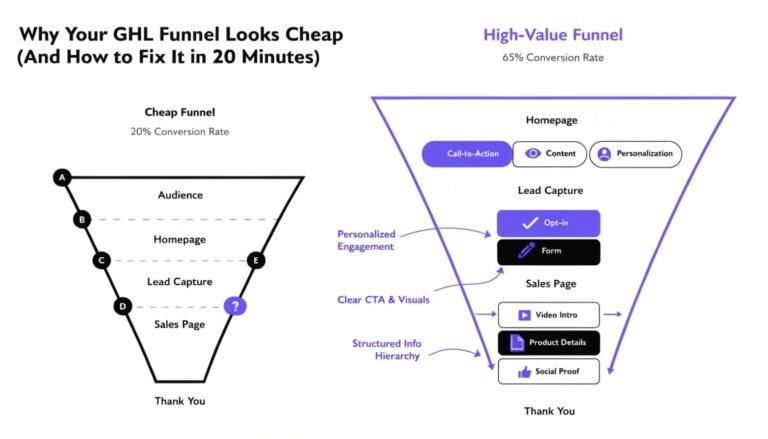
If you’ve been wondering why your own GHL funnel looks cheap, comparing it to a strong portfolio is the fastest way to see exactly what’s missing.
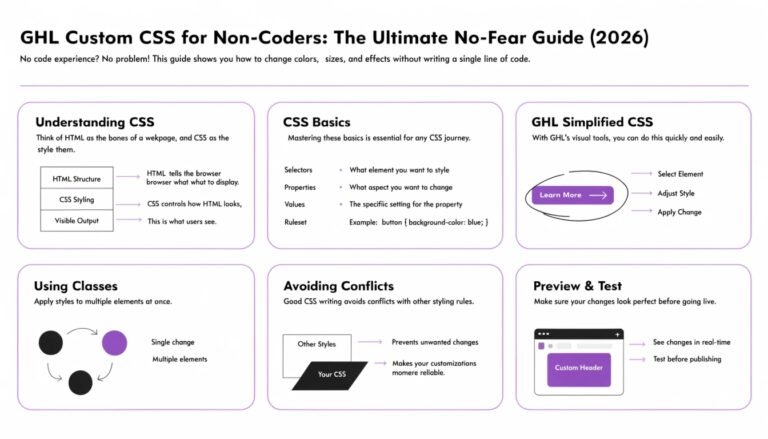
Do You Write Custom CSS or Only Drag-and-Drop?
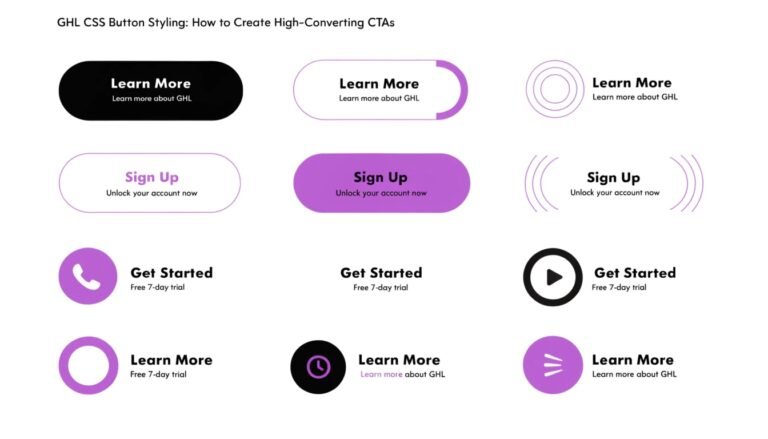
The strong answer: “Both. I use the drag-and-drop builder for layout and structure, then add custom CSS for typography, button styles, animations, and anything the builder can’t do.” A specialist will mention specific CSS techniques — selectors, pseudo-classes, media queries, custom properties.
The red-flag answer: “GoHighLevel has everything you need built in — you don’t need custom CSS.” This is what someone says when they don’t know how to write CSS. It’s not technically wrong, but it means your funnel will look like every other GHL funnel.
Why this matters: The drag-and-drop builder is identical across every GHL account. If your designer can only use the builder, your funnel will look like every other coach using GHL. Custom CSS is the only thing that visually separates a $500 funnel from a $5,000 brand.
Specific CSS skills to listen for:
A simple test: ask them to share one CSS snippet they’ve written. If they can’t produce one in 5 minutes, they don’t write CSS.
| Want to skip the hiring process entirely? If you only need 1–2 CSS fixes (button colors, font changes, hiding GHL branding, fixing mobile), send a screenshot and we’ll deliver production-ready CSS in 24 hours for just $47. Get a CSS fix for $47 → |
How Do You Handle Mobile Responsiveness?
The strong answer: “I design mobile-first, then desktop. I test on at least three real devices (not just Chrome DevTools) — iPhone, Android, and an iPad. I write separate CSS rules for breakpoints at 480px, 768px, and 1024px.” They might also mention testing on Safari (where many bugs hide).
The red-flag answer: “GoHighLevel handles mobile automatically.” It doesn’t. GHL’s mobile builder is decent but inconsistent — alignment breaks, font sizes shrink unpredictably, and buttons get cut off on smaller screens.
Why this matters: Statista reports that 62% of coaching website traffic in 2025 came from mobile devices. If your funnel doesn’t work on a phone, you lose the majority of your leads before they even read your offer.
Mobile issues to watch for in their portfolio:
For more on this specific problem, see our GHL mobile responsive CSS guide — it covers the exact breakpoints a good designer should be writing.
What’s Your Revision Policy?
The strong answer: A specific number of revisions in writing, with a defined revision window (typically 7–14 days). Example: “Three rounds of revisions included within 14 days of delivery. Additional rounds are $50 each.”
The red-flag answer: “Unlimited revisions until you’re happy.” This sounds generous but actually signals a designer who doesn’t value their time — which means they’ll rush to “done” quickly, then dread your feedback.
Why this matters: Vague revision policies are the #1 source of disputes in design contracts. Without a defined scope, “revisions” can mean anything from “change this button color” to “redesign the entire hero section.” Both freelancer and client end up frustrated.
What a good revision policy looks like:
| Element | What it should specify |
| Number of rounds | Usually 2–3 rounds included |
| Revision window | Window of 7–14 days after delivery |
| Scope of revisions | Tweaks, not redesigns (“change color” yes, “different layout” no) |
| Additional revision cost | Fixed price per additional round ($50–$150) |
| Out-of-scope changes | Treated as new project at hourly rate |
Get this in writing before you pay the deposit. A designer who refuses to commit to a written revision policy is signaling future conflict.
Who Owns the Funnel After Delivery?
The strong answer: “You own everything — the funnel, the CSS, the assets, the workflows. I’ll deliver it inside your own GHL account, not mine. You get full editing access from day one.”
The red-flag answer: “I’ll keep it in my agency account and you’ll log in through me” — or — “I retain rights to the design and you license it.” This is how some designers create lock-in, charging you ongoing fees to access your own funnel.
Why this matters: Ownership disputes are common in the GHL space because of how snapshots and sub-accounts work. Some designers build inside their own agency account and “transfer” via snapshot — but if the snapshot transfer fails or they refuse to share it later, you can lose everything.
Specific things to verify in writing:
If a designer pushes back on full ownership transfer, walk away. There are dozens of GHL specialists who deliver clean ownership as standard.
Read this: GHL vs. Kajabi for Coaches: Which is Best for Your Business?
How Long Is Your Turnaround?
The strong answer: A specific timeline tied to scope: “A 3-page coaching funnel takes 7–10 business days from kickoff. I’ll send you a project timeline with milestones — draft, revision round 1, revision round 2, final delivery.”
The red-flag answer: “It depends” — with no follow-up commitment. Or the opposite extreme: “I can do it in 48 hours” for a full custom funnel (this means they’re either using a template or cutting corners).
Why this matters: Realistic timelines reveal experience. A specialist who’s built 50 coaching funnels knows exactly how long each piece takes. A beginner either over-promises (and misses deadlines) or refuses to commit (and drags the project for months).
Typical turnaround benchmarks in 2026:
| Project type | Realistic turnaround |
| Single page CSS makeover | 2–3 business days |
| 3-page coaching funnel (custom) | 7–10 business days |
| 5-page funnel with automation | 14–21 business days |
| Full agency dashboard customization | 21–30 business days |
| White-label SaaS setup | 30–45 business days |
If a quote is much faster than these benchmarks, ask what they’re skipping. If it’s much slower, ask what they’re charging for.
Do You Offer Post-Launch Support?
The strong answer: “Yes — 14–30 days of bug-fix support included. After that, I offer a monthly retainer at $X for ongoing tweaks.” Some designers also offer GoHighLevel platform-update warranties (covering CSS that breaks when GHL pushes updates).
The red-flag answer: “Once delivered, the project is closed.” This is technically reasonable, but it leaves you completely on your own if something breaks the day after launch — and something always breaks the day after launch.
Why this matters: GoHighLevel updates its platform every 2–3 weeks. Updates frequently break custom CSS, especially around the calendar widget, chat widget, and order form selectors. Without post-launch support, you’ll be paying full hourly rates to fix something that was working last week.
Coverage to look for:
This question alone separates one-time mercenaries from designers who want long-term relationships. Coaches who launch and grow tend to need design help every 3–6 months — choose a designer you can keep working with.
GHL Designer Pricing Benchmarks 2026
Here are the current 2026 pricing ranges for GHL design work, based on rates we see across the freelancer market:
| Service | Low end | Average | High end |
| Single CSS snippet fix | $30 | $75 | $150 |
| One-page CSS makeover | $100 | $250 | $500 |
| 3-page coaching funnel (custom) | $400 | $1,200 | $3,500 |
| 5-page funnel with automation | $1,000 | $2,500 | $7,000 |
| White-label dashboard customization | $1,500 | $4,000 | $10,000 |
| Monthly retainer (ongoing) | $150/mo | $400/mo | $1,500/mo |
What drives price differences:
- Custom CSS depth — designers who write extensive CSS charge 2–3x more than drag-and-drop generalists
- Conversion expertise — designers who can show conversion lift data charge premium rates
- Niche specialization — coach-focused specialists charge more than generalists
- Geographic location — US/UK designers charge 2–4x more than offshore (quality varies)
Honest take: If you’re a new coach, you don’t need to hire the $5,000 designer. A $200–$500 productized service from a specialist will get you 90% of the way there.
| Pricing transparency, not estimates. Our GHL Full Funnel Design service is a flat $497 with a 7–10 day delivery and 3 included revisions. No quotes, no hourly billing, no surprise invoices. |
Hiring Mistakes That Cost Coaches Their Deposit
Across the 100+ coaches we’ve talked to at ghlcss.com, these four mistakes account for over 80% of failed designer hires:
Paying 100% upfront
A standard agreement is 50% deposit, 50% on delivery — or 30/40/30 split across kickoff, draft approval, and final delivery. Designers who demand 100% upfront have either been burned by clients (red flag — why?) or have no skin in the game once paid.
Skipping the written scope document
A scope document is a 1–2 page outline of: page count, included features, excluded features, deliverables, timeline, payment schedule, revision policy, and ownership terms. Without it, every disagreement becomes a “he said, she said.” If a designer won’t produce a scope doc, they’re not professional enough to hire.
Choosing the cheapest bid
In a 2025 review of 50 GHL design hires we surveyed, the cheapest bids had a 41% dissatisfaction rate versus 12% for mid-range bids. Cheap usually means: offshore, drag-and-drop only, no English-language communication, or a portfolio of stolen work. Mid-range is the sweet spot.
Not testing communication before hiring
Send the designer a small paid test ($50–$100 for a CSS fix or design audit) before committing to the full project. You’ll learn three things instantly: response speed, communication clarity, and actual skill level. A $50 test saves $500–$2,000 in deposit losses.
Frequently Asked Questions
How much does it cost to hire a GHL designer in 2026?
In 2026, hiring a GHL designer ranges from $30 for a single CSS snippet to $10,000+ for a full white-label dashboard. The average coaching funnel costs $1,200, and a productized service like ours runs $497 flat. The wide range reflects skill depth — designers who write custom CSS charge 2–3x more than drag-and-drop generalists.
Where can I hire a GHL designer?
You can hire GHL designers on Upwork, Fiverr, GoHighLevel Facebook groups, freelance directories, and specialist sites like ghlcss.com. The best results usually come from specialist sites or referrals — generic marketplaces have a 41% dissatisfaction rate due to inexperienced freelancers claiming GHL expertise.
How long does it take to hire and onboard a GHL designer?
Plan for 3–7 days of vetting (reviewing portfolios, scope calls, paid tests) plus 7–30 days for the actual project depending on scope. Total: 10–37 days from “I need a designer” to “live funnel.” Productized services like our Full Funnel Design shortcut this to about 10 days total.
What’s the difference between a GHL designer and a general web designer?
A GHL designer specializes in the GoHighLevel platform — they know its CSS selectors, automation triggers, calendar integrations, and template limitations. A general web designer can build websites in WordPress, Webflow, or Squarespace but typically doesn’t know GHL’s quirks. Hiring a general web designer for GHL work usually means 2–3x more revisions and a funnel that doesn’t fully use the platform.
Do I need to hire a designer or can I DIY my GHL funnel?
You can DIY if you’re comfortable spending 20–40 hours learning the platform, are willing to write CSS, and don’t mind a learning curve. Most coaches earn more per hour from their coaching than they’d save by DIY’ing — hiring is usually a better ROI.
What should be in a GHL designer contract?
A solid GHL designer contract includes: project scope (page count + features), timeline with milestones, payment schedule (50/50 or 30/40/30 split), revision policy (rounds + window), ownership terms (you own everything after final payment), post-launch support window, kill fee (early termination cost), and deliverables list (raw files, CSS, snapshots).
Can I hire a GHL designer for under $500?
Yes — productized services and CSS makeovers are available from $47 to $497. A full custom coaching funnel from a US-based specialist usually starts around $1,200, but if you only need styling fixes (not a full build), you can get professional work done for under $200. Our GHL Funnel CSS Makeover is $197 for an existing funnel.
What questions should I ask a GHL designer before hiring?
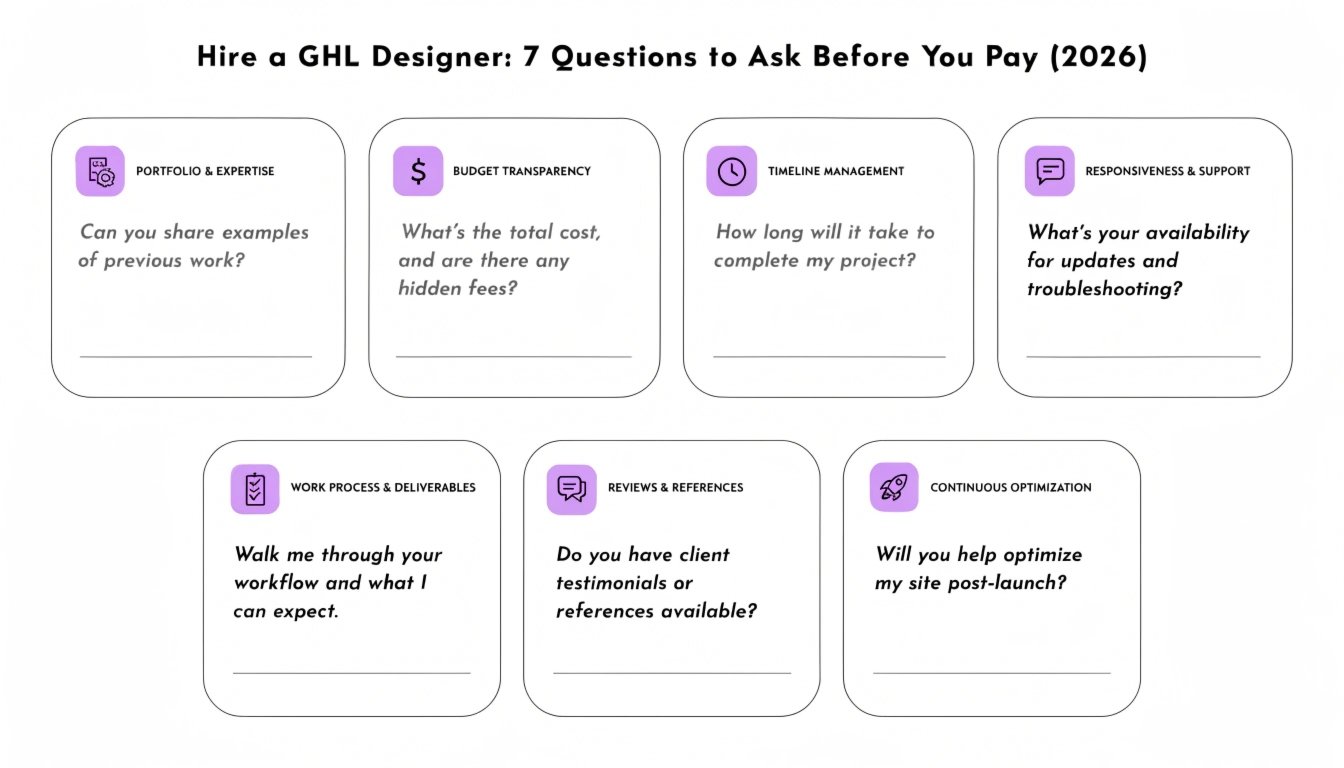
Ask these 7 vetting questions: (1) Can I see 3 coaching funnels you’ve built? (2) Do you write custom CSS or only drag-and-drop? (3) How do you handle mobile responsiveness? (4) What’s your revision policy? (5) Who owns the funnel after delivery? (6) How long is your turnaround? (7) Do you offer post-launch support? Strong specialists answer all 7 confidently with specifics. Generalists hesitate or generalize on at least 3.
Conclusion: Hire Smart, Launch Faster
Hiring a GHL designer isn’t about finding the cheapest option or the most impressive sales page. It’s about finding a specialist who answers seven specific questions with specific answers — and who shows you live portfolio work to back them up.
The 15 minutes you spend on these seven questions saves an average of $2,300 and 6 weeks of misfires. The hiring checklist above is built to be reused: print it, take it to every designer call, and refuse to pay a deposit until every box is checked.
If you want to skip the hiring process entirely, ghlcss.com offers productized GoHighLevel design services starting at $47 for single CSS fixes and $497 for full 3-page coaching funnels — flat pricing, 48-hour to 10-day turnaround, full ownership transfer, and 30 days of post-launch support included by default.