
GHL Funnel for Executive Coaches: Premium Design Playbook (2026)
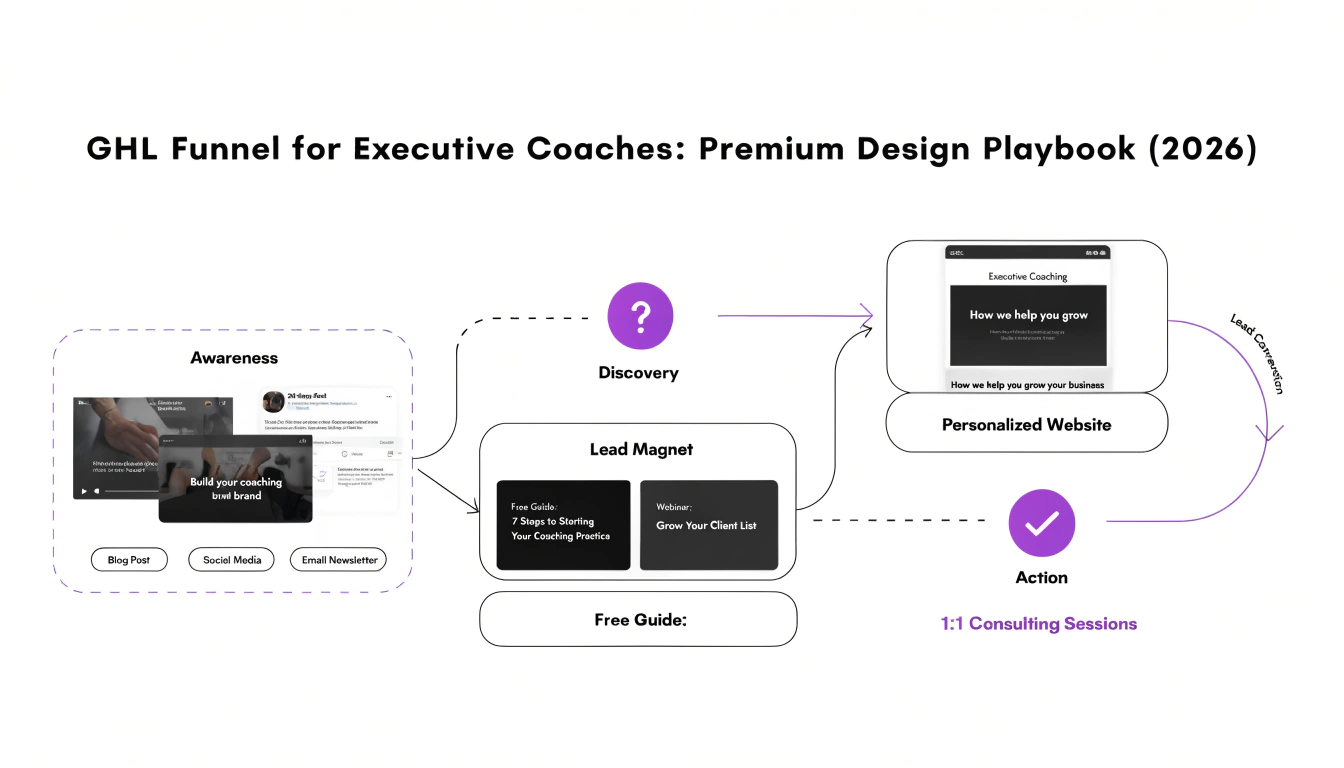
| A high-converting GHL funnel for executive coaches converts on understatement, exclusivity, and verifiable credentials — not on urgency or persuasion tactics. The winning structure has six sections: (1) a restrained hero with a single named credential, (2) a discreet “who I work with” positioning block, (3) a measured client-results section using named C-suite titles, (4) a methodology or framework presented as IP, (5) a private application CTA (not a public calendar), and (6) a confidentiality note. Visually, executive funnels use deep navy or charcoal, serif typography, generous whitespace, and zero stock photography. Selling to a CFO is the opposite of selling to a wellness buyer — they’re evaluating you the way they’d evaluate a McKinsey engagement, and your funnel needs to match. |
What Is a GHL Funnel for Executive Coaches?
A GHL funnel for executive coaches is a sequence of pages built in GoHighLevel — typically a positioning page, a private application page, and a confirmation page — designed to qualify senior leaders for high-ticket engagements ranging from $10,000 to $100,000+. Unlike a general coaching funnel that aims for volume, an executive funnel is engineered for selectivity. Its job is to filter out the wrong fit and book the right one.
In our experience designing funnels for executive and leadership coaches at ghlcss.com, the single sharpest difference from any other niche is the signal-to-noise ratio expected by the buyer. A CFO or CEO evaluating an engagement reads a funnel like they’d read a Bain proposal. Every animation, urgency timer, or rotating testimonial slider doesn’t add credibility — it subtracts it. Restraint is the entire game.
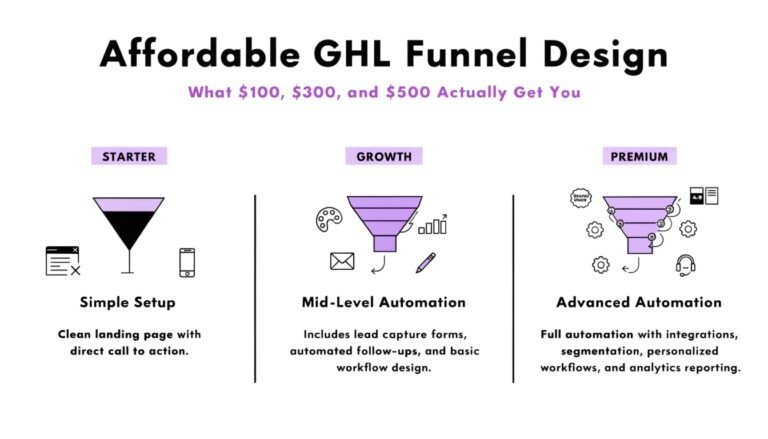
| Want this built premium without the agency price? Our GHL Full Funnel Design service delivers a complete 3-page executive funnel in 7–10 days for a flat $497 — the same restrained, credentials-led design principles agencies charge $5,000+ for. |
Why Executive Funnels Follow Different Rules
Most GHL templates are built for either low-ticket products or audience-driven coaching. Executive coaching is neither. Here’s what changes when your buyer is a senior leader:
This is one of the sharper contrasts in the coaching world. A life coaching funnel wins on warmth; a business coach funnel wins on ROI proof. An executive funnel wins on what it doesn’t do — it doesn’t push, doesn’t flash, doesn’t persuade. It positions.
The 6-Section Premium Funnel Structure
Every high-converting executive coaching funnel we’ve built follows this exact section order. Use it as your page skeleton.
Section 1: Restrained hero with a single named credential
No headline like “Transform your leadership.” Lead with a specific positioning statement and one verifiable credential. Example: “Executive coaching for technology CEOs scaling past $50M ARR. Former Bain partner. 14 years in C-suite.” One quiet CTA: “Request an Introduction.”
Section 2: “Who I work with” positioning block
Be specific about who fits and who doesn’t. “I work with CEOs of $20–$200M technology companies. I don’t take engagements with founders earlier than Series B or operators outside SaaS.” Selectivity is the signal.
Section 3: Client results using named C-suite titles
Use titles and outcomes, not testimonials. “CEO, Series C SaaS company, doubled headcount in 18 months without burnout.” Real first names with permission, or anonymized titles when not. Never use stock-image testimonials.
Section 4: Methodology presented as intellectual property
Name your framework. Treat it like consulting IP. Three or four named phases, each defined briefly. Senior leaders buy systems, not personalities. Example: “The Quiet Authority Framework: Diagnose → Reframe → Stabilize → Scale.”
Section 5: Private application CTA (not a public calendar)
Don’t embed a public Calendly. Use an application form that gates the calendar behind a screening step. The gate itself signals selectivity. The application captures fit (title, company stage, current challenge) before any time investment.
Section 6: Confidentiality note
A short, formal note at the bottom: “All inquiries are confidential. Your engagement is never discussed publicly or used in marketing without written consent.” This is the trust signal that closes the gap for cautious senior buyers.
The Visual Language of Executive Credibility
The visual choices are what distinguish a $50,000 executive coach’s funnel from a $5,000 life coach’s. Here are the choices that signal premium credibility at first glance.
| Element | Premium executive | Avoid (signals wrong tier) |
| Color palette | Deep navy, charcoal, ivory, cool stone | Bright accents, gradients, neon, pastels |
| Typography | Classical serif (Garamond, Lyon, Tiempos) | Decorative scripts, all-caps sans, multiple display fonts |
| Imagery | Architectural, abstract, minimal portrait, or none | Stock smiles, handshakes, generic offices, mountaintops |
| Shapes | Hard edges, sharp rectangles, thin rules | Rounded corners, soft shadows, organic blobs |
| Animation | None or single subtle fade | Sliders, counters, scroll-triggered effects |
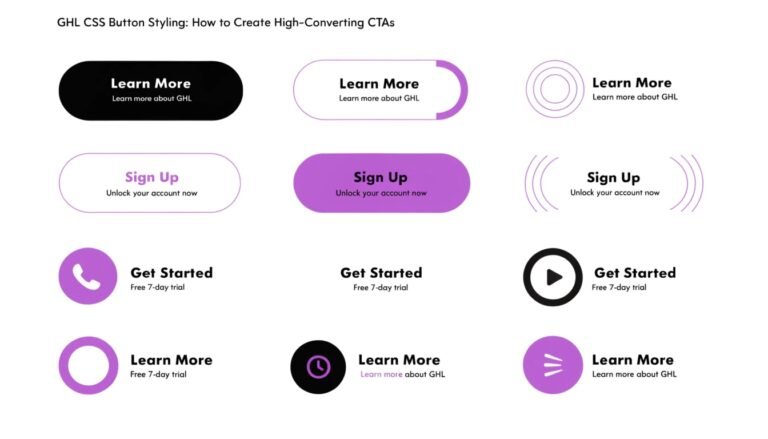
| Buttons | Outlined or single-line, restrained padding | Glossy, gradient, oversized, urgent colors |
| Whitespace | Generous, confident silence | Dense, busy, urgent |
| Trust signals | Logos of prior companies, education, publications | Star ratings, review counts, “as featured in” |
The pattern across all eight rows is the same: subtraction. Executive funnels read as premium because they remove everything that signals “marketing.” If you’re unsure whether to add an element, default to not adding it.
Copy-Paste CSS for a Premium Executive Aesthetic
Paste the CSS below into GHL → Sites → Funnels → your funnel → Settings → Custom CSS. These styles create the restrained, classical, premium feel executive coaching demands.
Color and type system
| /* Executive palette: navy, charcoal, ivory */ :root { –ink: #0F1B2D; /* deep navy */ –char: #2A2D34; /* charcoal text */ –ivory: #F7F4EF; /* warm off-white background */ –stone: #8C8D8F; /* cool stone for accents */ –rule: #DCD9D2; /* horizontal rule */ } body { background: var(–ivory); color: var(–char); } /* Classical serif headlines, humanist sans body */ h1, h2, h3, h4 { font-family: ‘Cormorant Garamond’, ‘Garamond’, serif; color: var(–ink); letter-spacing: -0.5px; font-weight: 500; } body, p, li { font-family: ‘Inter’, sans-serif; font-size: 17px; line-height: 1.7; } |
Restrained button (outlined, not glossy)
| /* Single-weight outline button — confidence through restraint */ .ghl-btn, .c-button { background: transparent; color: var(–ink); border: 1px solid var(–ink); border-radius: 0; /* sharp corners */ padding: 14px 36px; font-family: ‘Inter’, sans-serif; font-weight: 500; letter-spacing: 0.4px; text-transform: uppercase; font-size: 13px; transition: background 0.2s ease, color 0.2s ease; } .ghl-btn:hover { background: var(–ink); color: var(–ivory); } |
Editorial section dividers and whitespace
| /* Section spacing that reads as confident, not crowded */ .section { padding: 120px 24px; } @media (max-width: 768px) { .section { padding: 64px 20px; } } /* Thin rule dividers between sections */ .section + .section { border-top: 1px solid var(–rule); } /* Pull-quote style for client results */ .client-result { font-family: ‘Cormorant Garamond’, serif; font-size: 24px; font-style: italic; line-height: 1.5; max-width: 640px; margin: 0 auto; color: var(–ink); } |
To load Cormorant Garamond or other premium fonts, follow our GHL custom fonts guide. For more nuanced selector targeting, see the GHL CSS selectors guide.
Application vs. Public Calendar: Why the Gate Matters
This is the single biggest funnel design decision unique to executive coaching. A public calendar (“Book a free call!”) signals you’re selling time. An application (“Request an introduction”) signals you’re selecting clients. The latter converts senior leaders at meaningfully higher rates because it matches the buyer’s mental model of a serious engagement.
A practical application form for executives asks 5–7 questions, not 20:
After submission, you review applications and only invite suitable candidates to a private booking link. The asymmetry — they apply, you decide — is what reads as premium.
| Want the executive funnel built for you? We design the full 6-section executive funnel — hero, positioning, results, methodology, application gate, confidentiality — for a flat $497. Full Funnel Design → |
Writing Copy That Doesn’t Talk Down to Senior Leaders
Design sets the tone; copy seals the trust. Five rules for executive coaching funnel copy:
The tone you’re aiming for is what a senior partner at a respected firm would write: confident, specific, brief.
4 Mistakes That Disqualify You Immediately
Senior leaders make snap judgments. Any one of these four mistakes typically ends the engagement before the buyer reads a second paragraph:
Each one reads as a single mismatched detail. Stack two or more, and the senior buyer assumes the rest of your work is also mismatched. Restraint protects you here.
The Executive Coach Funnel Checklist
Use this before publishing.
| Launch item |
| Hero leads with verifiable credential, not aspiration |
| “Who I work with” block is specific (titles + company stage) |
| “Who I don’t work with” is named or implied |
| Client results use real titles, not stars or stat-only testimonials |
| Methodology presented as a named framework with phases |
| Application form replaces public calendar |
| Confidentiality note included at the bottom |
| Palette is restrained (navy, charcoal, ivory — no bright accents) |
| Classical serif headlines applied via CSS |
| Buttons are outlined, not filled or glossy |
| No countdown timers, sliders, or urgency language |
| No stock-photo handshakes or generic office imagery |
| Generous whitespace at desktop and mobile |
| Tested on a real phone (executives often read on mobile during commutes) |
| FAQ schema + Article schema added in Rank Math |
Frequently Asked Questions
What makes an executive coach funnel different from a business coach funnel?
An executive coach funnel sells to senior leaders (CEOs, CFOs, board members) at $10,000–$100,000+ engagements, while a business coach funnel sells broader B2B coaching at $3,000–$25,000. Executive funnels win on understatement, verifiable credentials, and application gates. Business funnels win on ROI proof and clear methodology. The visual languages are different too: executive funnels avoid the corporate-bright look in favor of editorial restraint.
Should an executive coach use a public booking calendar in GoHighLevel?
No. An executive coach should not use a public booking calendar. Instead, use a private application form that captures fit (title, company stage, outcome wanted, timeline, budget) and only invites suitable applicants to a gated calendar link. The gate itself is the premium signal — it reads as selectivity rather than availability.
What colors work best for an executive coaching funnel?
Restrained colors work best for executive coaching funnels: deep navy, charcoal, ivory, and cool stone. Avoid bright accents, gradients, neon, and pastel palettes — these signal lifestyle coaching to a C-suite buyer. The visual cue you want is editorial, like a Harvard Business Review article rather than a marketing landing page.
How much does a GHL funnel for executive coaches cost?
A GHL funnel for executive coaches ranges from $200 for a CSS makeover on an existing funnel to $3,500 for a fully custom multi-page funnel with application logic and integrations. A productized 3-page funnel with the restrained executive aesthetic runs around $497 flat. Most executive coaches need the $497 tier minimum because the design choices that read as premium are easy to get wrong at lower tiers.
What credentials should appear on an executive coaching funnel?
Credentials on an executive coaching funnel should be verifiable and specific: prior C-suite roles, named former employers (especially recognized consulting firms or category-leading companies), education at recognized institutions, published work, board roles, and client outcomes tied to named titles. Avoid generic credentials like coaching certifications, course completions, or follower counts — senior leaders weight these much lower than direct experience.
Do executive coaches need a long sales page or a short one?
Executive coaches usually convert better with a shorter, restrained landing page (600–900 words visible above the form) than a long sales letter. Senior leaders make qualification decisions quickly based on signal density. A 3,000-word sales page reads as audience-coaching territory; a tightly written 700-word positioning page reads as advisory territory.
Should I show client logos on my executive coaching funnel?
Yes, you should show client logos on an executive coaching funnel if you have permission — named companies are the strongest single trust signal for senior buyers. If you don’t have permission to name clients, name the companies you’ve worked at previously or the firms where you’ve advised, and reference engagements by title and outcome without naming the company.
Conclusion: Position, Don’t Persuade
A GHL funnel for executive coaches wins on what it removes — urgency tactics, stock photography, public calendars, marketing-speak — not on what it adds. Lead with verifiable credentials. Be specific about who you work with and who you don’t. Present your methodology as intellectual property. Gate the calendar behind an application. Use restrained navy, ivory, and classical serif typography. Add a confidentiality note. Test it on mobile.
The aesthetic that converts a CFO is the aesthetic of a senior consulting partner: confident silence, deliberate choices, no flash. Build the funnel that reads the way you’d want a McKinsey proposal to read — and your engagement quality will follow.
| Want a premium executive funnel built without agency overhead? Our GHL Full Funnel Design service delivers the complete 6-section executive funnel in 7–10 days for a flat $497 — or start with a $197 CSS makeover to apply the executive aesthetic to your existing funnel. |